
Transparent testing (product quality), and realistic expectations remain essential. The complete KLOW peptide blend has not been adequately evaluated in human clinical trials. It is already used in some topical skin and hair-care products. BPC-157 and thymosin beta-4-related compounds have been examined in preclinical tendon and ligament models. They do not prove that the blend improves athletic performance or shortens recovery time. KLOW is sometimes discussed within fitness (bodybuilding), and athletic recovery communities.
Using a sterile syringe, draw the desired volume of bacteriostatic water and inject it slowly down the inside wall of the vial, not directly onto the powder. Related compounds and blends are comparisons only, not interchangeable. The peptide mass in that volume depends on the vial contents and final reconstitution volume. The page’s reconstitution guide uses 3.0 mL of bacteriostatic water per vial. Avoid repeated freeze-thaw cycles and follow the verified product-specific discard information for the exact batch. The KLOW blend does not have a controlled human safety study in the cited literature.
That theory has not been tested in any published study. The theory behind blends is that synergistic effects compensate for lower individual doses. A 2020 safety evaluation found no serious adverse effects at 1000mcg/kg for 90 days in animal models.
A rest period of 2 to 4 weeks between cycles is common practice. Recovery benefits from KLOW can appear faster, often within the first 2 buy MOTS-c peptide weeks for injury-related use. Skin improvements from GLOW typically become noticeable by weeks 3 to 4 and continue improving through week 8. Serious adverse events are rare with both blends at standard doses. These settings are saved to this browser and you can change them at any time. Each plan is a one-time payment, due only if a provider prescribes it.
A note on results timelines
Consult the current product listing for the amount of each component and the exact molecular specifications. KLOW is a combined research formulation containing four distinct peptide components. Once reconstituted, plan to use within 4 to 6 weeks refrigerated. You add bacteriostatic water before use.

Dermal collagen remodelling genuinely operates on a scale of weeks to months, consistent with the human topical GHK-Cu data. The weeks 4-8 skin window is the only row whose timing lines up with an independently established process. GHK-Cu (matching the 4-8 week timescale of dermal collagen turnover No clinical trial has tracked outcomes on KLOW), so there is no verified timeline. No published study has ever tested the KLOW combination. For anyone running a multi-week protocol, that difference is real and immediate, and it is probably the single largest driver of KLOW’s popularity.
I use Everest personally and it’s the only vendor I recommend to BrainFlow readers for KLOW. Either purity is low (one of the four peptides is light), or they’re cutting corners on manufacturing conditions that matter when you’re working with these compounds. Everest sells out, and KLOW is one of the products that goes first. Joint inflammation lessens over a couple of weeks with consistent dosing. This is exactly why I use Everest Peptides for KLOW.
BPC-157 and TB-500 tissue remodeling continues for weeks post-cycle based on animal data. No human data exists for this time window specifically. This is the window where GHK-Cu-mediated collagen and elastin synthesis hits its stride, based on gene expression timelines from Pickart’s research. GHK-Cu activates fibroblast signaling within hours of injection; BPC-157 and KPV reach tissue concentrations within days based on animal PK data. GHK-Cu delivers bioavailable copper; at moderate tier , 2500mcg GHK-Cu/day, or aggressive tier (3000mcg/day) copper accumulation is a risk over 10 weeks When paired with a GLP-1 agonist, additive GI effects in the first two weeks of overlap deserve attention.
Locate clinics that provide the KLOW Peptide Blend.
Standard cycles run 8-12 weeks, followed by 4-8 weeks off. For standard protocols, using blends proves to be both practical and economical. Storage is at 2–8°C; community protocols note a 28-day use window after reconstitution. The 0.3cc 31G syringes have gradation marks indicating 1 unit each , as opposed to 2 units for the 1cc,, ensuring precision for peptide doses below 50 units. The documented dilutions in community reconstitution protocols are represented by these conversions.
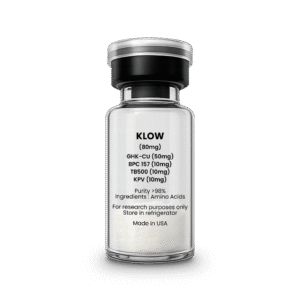
Why Is the Klow Blend More Effective Than Individual Peptides?
Sold together in a single vial, this product consists of four peptides whose name is an acronym denoting its components. It is advisable for anyone interested in these compounds to seek guidance from a qualified expert. There is an absence of sex-stratified data for KLOW due to the lack of any study on KLOW. The realistic risk profile encompasses both uncharted pharmacological effects and a known risk of sourcing and purity from unregulated suppliers. Only the last mentioned window aligns with an established biological timescale related to dermal collagen turnover.
Engage with expertly developed content focusing on supplements (longevity), and maximizing both mental and physical performance. When drawing a standard 10-unit daily dose (a vial lasts for 20 days), resulting in approximately $3.57 per day on sale, compared to nearly $4.95 per day when purchasing the four peptides individually at the same discount. The assumed route for delivering all four peptides systemically is via subcutaneous injection, which is the basis for every protocol discussed in this article. To the 80mg vial (add 2 mL of bacteriostatic water by directing the flow along the glass rather than onto the powder), and then gently roll the vial. Purchasing them separately in four vials results in a cost increase of about 28%.
The components of KLOW: Four key ingredients.
Community feedback indicates injection-site reactions within days, subjective inflammatory responses after two to four weeks, and skin alterations occurring between four to eight weeks. In research environments, KLOW is reconstituted with bacteriostatic water and administered subcutaneously, typically in cycles lasting several weeks. This product is not simply four compounds with identical functions sold at quadruple the cost. KLOW is more logical for studying multi-pathway recovery, as the fixed ratio keeps the four variables consistent. Our comprehensive comparison of KLOW versus GLOW presents both blends side by side (detailing ratios), research themes, and the impact of KPV on each formulation’s study purpose. Reported quantities differ based on the study model, administration route, duration, and monitoring needs, and Peptidelogy does not offer usage protocols.
Educational protocols recommend dosing the KLOW peptide blend at 250 mcg–750 mcg daily through subcutaneous injection. Priced at $135 for the entire stack, it offers significant value to researchers conducting multi-pathway healing studies. One vial contains all four peptides (meaning that a single volume determines the doses for all four), and individual adjustments cannot be made.